- L-Plate Retiree
- Posts
- Retirement Made Me Invisible: Rebuilding an Identity That's Mine
Retirement Made Me Invisible: Rebuilding an Identity That's Mine
A retired teacher's honest reckoning with the moment she realised her identity belonged to her institution, not herself.
Sponsored by


because retirement doesn’t come with a manual
Another interesting piece. Perhaps I will never understand Marlene’s feeling, nor struggle like her, since I’ve never been in a job that long.
CS

Records again. The NASDAQ just posted its longest winning streak since 2009.
The quick scan: Thursday delivered a fourth consecutive record session. The S&P 500 closed at yet another all-time high, the NASDAQ extended its winning streak to 12 straight days – its longest run since July 2009 – and the Dow finally joined the party with a modest gain. The diplomatic backdrop continued to improve: Trump brokered a Lebanon ceasefire between Lebanese President Aoun and Israeli PM Netanyahu, effective Thursday evening, and told Fox Business that the Iran war is "very close to over." Pakistan's army chief met Iranian officials in Tehran, keeping ceasefire extension talks alive. Markets absorbed all of this calmly and kept climbing.
S&P 500: +0.26% to 7,041.28 – a new all-time closing record, with an intraday high of 7,051.23; the index has now risen in ten of the past eleven sessions and sits 11% above its war-period low
Dow Jones: +0.24% to 48,578.72 – added 115 points in a broad but quiet session; PepsiCo rose on better-than-expected Q1 earnings while Charles Schwab fell 3.9% and Abbott Laboratories dropped 4% on weak guidance
NASDAQ: +0.36% to 24,102.70 – the twelfth consecutive day of gains, the longest win streak since July 2009; TSMC raised its full-year capex guidance to the upper end of $52–56bn on AI chip demand, further anchoring the technology rally; Netflix fell 10% in after-hours after announcing chairman Reed Hastings will leave in June.
What's driving it: The market has decisively separated the Iran story into two buckets: the ceasefire-and-diplomacy bucket (increasingly positive, Lebanon deal done, Iran talks continuing) and the Strait-of-Hormuz-shipping bucket (still unresolved, but oil at $90 suggests markets expect resolution). VIX fell to 17.79 – its lowest level since before the war began. The 10-year yield ticked up 3.4 bps to 4.313%, a mild headwind that the equity market is shrugging off. Earnings season continues with generally solid results from the big banks.
Bottom line: Four new all-time highs in four sessions. The NASDAQ's 12-day win streak is the kind of statistic that makes investors nervous – not because winning streaks are inherently dangerous but because they breed complacency. The Iran war is not yet over, the Strait is not yet fully reopened, and Netflix's after-hours drop is a reminder that earnings season still has teeth. For L-Plate Retirees, the week's lesson remains what it was on Monday: the plan matters more than the moment. Those who held through the blockade announcement are now sitting on new highs. Those who didn't will find it harder to decide when to get back in.
Stop Reading About AI. Start Getting Results From It.
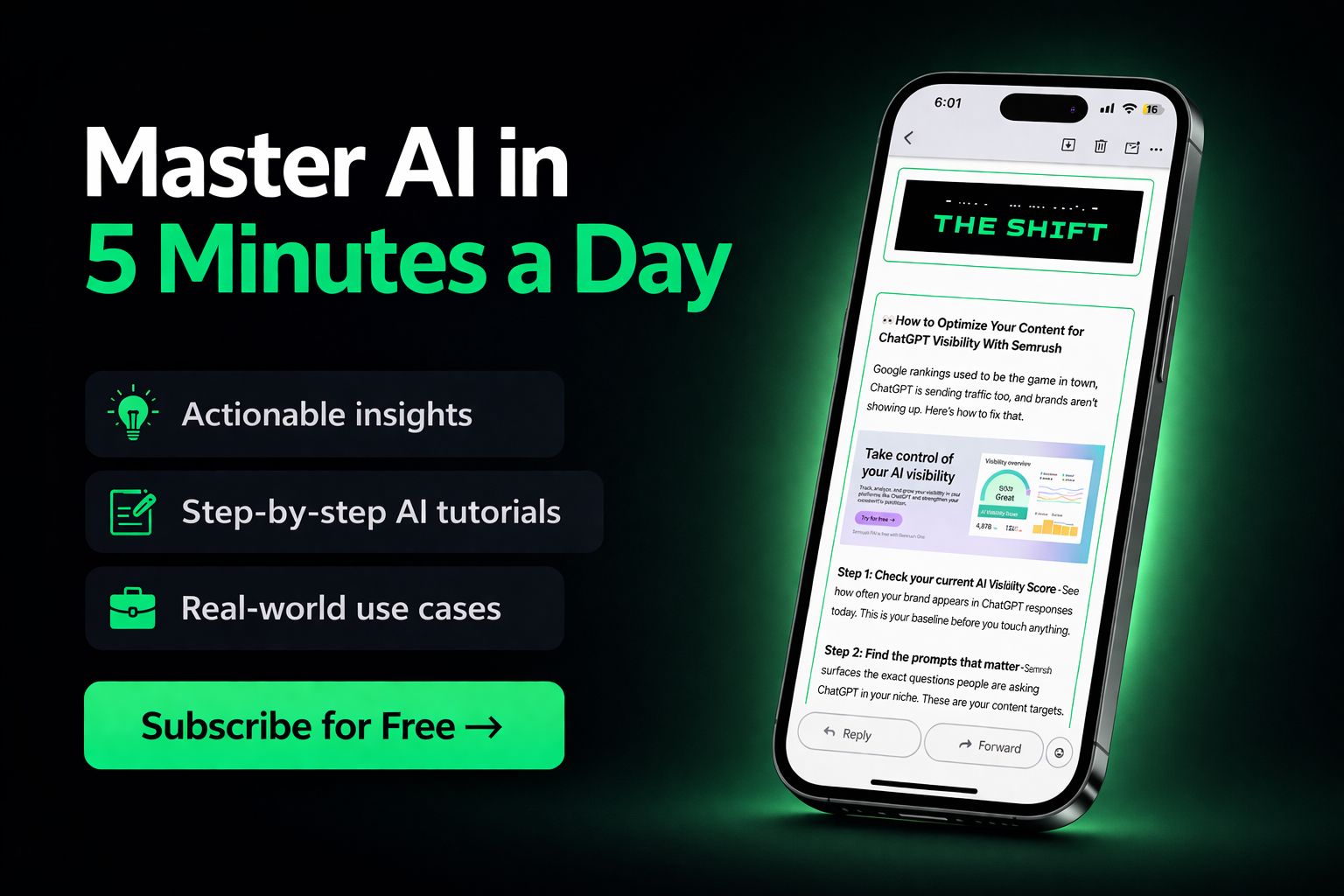
AI is everywhere, but practical, actionable ways to use it are really rare to find.
The Shift fixes this with focus on a single topic per edition. A real problem AI can solve today.
You’ll see real examples, short workflows, and proven prompts that help you work faster, think better, and automate intelligently under 5 minutes a day.
Once you subscribe, you get access to 3,000+ curated AI tools and 1000+ prompts, so nothing stays theoretical.
If you want AI to work for you in real practical ways, not just ideas, you’ll love The Shift.
And right now, 3 subscribers win a free 1-year Claude Pro subscription. One click to enter.

The System Replaced Me in Three Weeks. Here's What I Learned From That

do you fell invisible too?
The scoop: Marlene Martin retired at 64 with a decent pension and good health. By most measures, she had done everything right.
Six weeks into retirement, she drove past her school on the way to a doctor's appointment. She hadn't planned to look. But you can't drive past a building you entered every morning for 32 years without glancing. The parking lot was full. A new nameplate was on the door of room 214 – her room, the one she'd arranged and rearranged for two decades, where the afternoon light hit the reading corner just so and she'd built lesson plans around the geometry of it.
Her replacement was Jennifer. She was 34, enthusiastic, and had a master's degree in something that didn't exist when Marlene started teaching. The school had hired her three weeks after Marlene left.
Three weeks. To replace 32 years.
Marlene sat in the doctor's parking lot for a long time afterwards. Not crying. Something flatter than crying. Something that felt, she writes in a recent essay for VegOut, like watching your house still standing perfectly after you've moved out – and realising the house was never yours. You just lived in it.
The identity that was on loan.
For 32 years, when someone asked what she did, Marlene said "I teach." Not "I'm a teacher." The present tense was the point. The doing was the being.
That identity felt bone-deep. Permanent. Woven in. But it wasn't hers. It belonged to the position, the room, the institution. When she left, it stayed behind – and Jennifer put it on three weeks later and it fit her fine.
What Marlene took home was what was underneath: a woman she barely recognised. No title. No daily performance. No reliable external proof that she mattered to something larger than herself. She woke at 5:30 out of habit – and lay in bed realising the habit no longer had a destination.
The invisibility that wasn't what she expected.
The invisibility wasn't social neglect, and Marlene is precise about this. Her family called. Her friends were present. The world hadn't deleted her.
What had changed was how the world reflected her back to herself. When she was teaching, she walked into a building every morning and was met with daily, structural evidence of her own relevance. Students who needed her. Colleagues who consulted her. The building itself needed her presence to unlock the room and power the lesson.
Retirement withdrew the proof. Not the mattering – she still mattered to her family, her friends, the women at the shelter where she volunteered. But the institutional evidence of necessity disappeared. Without it, she felt like a word erased from a sentence. The sentence still worked. You couldn't even tell something was missing.
That was the worst part.
The therapist's list.
Her therapist asked her to make a list: what belonged to the position, and what belonged to her.
The position provided: the classroom, the schedule, the curriculum, the students, the title, the institutional framework. Remove the position, and all of that disappears.
What belonged to her: the ability to read a room of 30 teenagers in under a minute. The patience to sit with a struggling reader until the breakthrough arrived. The instinct for when to push and when to stay silent. Thirty-two years of accumulated wisdom about teaching, listening, holding a space where people could think without being afraid.
All of it was hers. None of it had anywhere to go.
Her image for this is a surgeon's hands after retirement: still capable, still precise, holding the memory of ten thousand procedures – but with no operating room to enter. The hands don't forget. They just close around nothing.
The slow return.
The invisibility lifted the way fog lifts – unevenly, in patches, with some areas clearing long before others.
Tutoring at the community centre helped. Sitting across from an adult learner, watching someone sound out a word for the first time, she felt what she calls the old current – the electricity of being present for the moment understanding arrives. The skill had somewhere to land, and the landing felt like being seen again.
Writing helped more than anything. When she started personal essays at 66, she wasn't looking for a replacement identity. But what the writing gave her – unexpectedly – was a way of mattering that didn't depend on an institution. The words were hers. Nobody could replace them in three weeks. They came from a person, not a position.
And then the garden. Not because tending roses compares to shaping a young mind. But because the garden needs her specifically – the woman who knows this particular bed needs shade by July, that the peonies take years to establish, that the soil along the fence runs acidic. Jennifer can't do it. Nobody can, except her.
She calls it a small sovereignty. After six months of feeling replaceable, small sovereignties turn out to be everything. Six years later, she's learning to build things that can't be replaced in three weeks – and that, it turns out, is the whole project.
Actionable takeaways for L-Plate Retirees:
Before you retire, ask yourself honestly: what is mine, and what belongs to the position? Marlene's therapist gave her this exercise and it nearly broke her. That's because most of us have never separated our skills, wisdom and capabilities from the institutional context that houses them. Doing this work before you leave – not after – gives you a clearer sense of what you're actually taking with you.
The invisibility of early retirement is real, and it's not the same as loneliness. You can have a full social life and still feel structurally irrelevant. The proof of mattering that an institution provides every day – people needing you, systems depending on you – disappears overnight when you retire. Naming this for what it is (identity disruption, not depression) is the first step toward addressing it.
Look for places where your skills have somewhere to land. Marlene found tutoring. The skills you built over a career are genuinely yours – they don't disappear when the position does. But they need a new context, and finding that context is one of the most useful projects of early retirement.
Build things that are non-transferable. This is the garden insight: the most durable sense of self in retirement comes from things that depend on you specifically – your particular accumulated knowledge, your particular relationships, your particular voice. The book only you can write. The community only you would build that way. The grandchildren who know your specific stories. Institutions can replace a role. Nobody can replace a person who has built something genuinely particular.
Give yourself the full first year. Marlene describes six months of feeling nearly invisible before things began to shift. If you're in that window and it feels harder than you expected, that's not a sign something has gone wrong. It's the normal duration of a major identity transition.
The 5:30am habit without a destination is the real retirement. When the structure that gave your morning its meaning disappears, you're left with yourself – often for the first time in decades. Many people find this terrifying. A few, eventually, find it the most interesting thing that has ever happened to them.
Your Turn:
When you think about what you do for work – or what you did – how much of that feels like yours, and how much feels like it belongs to the role or organisation? Have you ever sat with that question properly?
Marlene describes the invisible grief of retirement as the withdrawal of structural proof of relevance, not the withdrawal of love or friendship. Does that distinction resonate with your own experience, or what you've observed in others who've retired?
She ends with the idea of building things that can't be replaced in three weeks. What are the things in your life right now that are genuinely and irreplaceably yours?
👉 Hit reply and share your thoughts – your answers could inspire fellow readers in future issues.
If today's issue sparked a conversation worth having – with your partner, or just with yourself – consider supporting L-Plate Retiree on Ko-fi.
Protect Client Trust in Volatile Markets

When markets get shaky, advisors don’t just manage portfolios. They manage a surge of client emails, questions, and last-minute meetings. BELAY’s free Financial Advisor’s Delegation Guide shows how better delegation protects responsiveness, reduces bottlenecks, and helps your firm stay client-facing when pressure and volume rise fast across the entire firm.
Ready to take control of your retirement planning? Join our community of L-Plate Retirees who are learning to navigate this next chapter with confidence (and a bit of humour).
Subscribe now and get practical tips delivered to your inbox every weekday – because retirement doesn’t come with a manual, but it should come with a plan.
And if today’s issue gave you a smile or an “aha!” moment, you can always buy us a coffee on Ko-fi ☕ to keep the ideas brewing.
Because retirement doesn't come with a manual... but now it does come with this newsletter.
The L-Plate Retiree Team
(Disclaimer: While we love a good laugh, the information in this newsletter is for general informational and entertainment purposes only, and does not constitute financial, health, or any other professional advice. Always consult with a qualified professional before making any decisions about your retirement, finances, or health.)
Reply