- L-Plate Retiree
- Posts
- The 9-Minute Daily Habit That Keeps Your Body Working for You
The 9-Minute Daily Habit That Keeps Your Body Working for You
Mobility expert Joe Yoon says stiffness and limited movement are not inevitable parts of ageing – and nine minutes a day is enough to start reversing them.
In partnership with


because retirement doesn’t come with a manual
This is one area in fitness that is underrated. It is probably assumed that if you do any exercise at all, this benefit will naturally be accrued to you? Until you get a reminder – often rudely – that you are no longer a young chicken.
CS

A peace plan surfaces. Oil retreats. Markets extend the recovery.
The quick scan: Wednesday brought a third consecutive day of gains as reports emerged that the US had sent Iran a 15-point ceasefire proposal via Pakistan. Oil pulled back sharply, yields fell, and all three major indices rose. Iran's state media said it would reject the plan and countered with its own five-point proposal – but markets focused on the existence of negotiation rather than the details of its outcome.
S&P 500: +0.54% to 6,591.90 – a third straight gain, clawing back ground lost during last week's sharp sell-off
Dow Jones: +0.66% to 46,429.49 – broad-based gains with Amazon, Amgen, and Boeing leading; defensive names like Disney and Verizon lagged
NASDAQ: +0.77% to 21,929.83 – tech recovered steadily as the inflation outlook softened on falling oil prices, though Micron fell a further 4% as investors continued to digest its capital spending profile.
What's driving it: The AP and New York Times both reported the US ceasefire proposal, delivered through Pakistan, and the news was enough to push Brent crude below $97 and WTI to around $90 – a meaningful pullback from the highs above $113 seen earlier this month. The fall in energy prices brought Treasury yields lower, with the 10-year dropping to 4.33%, easing the inflation concerns that had driven the Fed's hawkish stance. Asset managers rallied as redemption pressure on private credit funds appeared to ease. JetBlue surged 18% on reports it is exploring a merger. Iran's counter-proposal – which includes demanding control of the Strait of Hormuz – was not the answer Washington was looking for, but even the existence of a diplomatic channel is more than markets had priced in a week ago.
Bottom line: The week's pattern is now clear: bad news sends markets down sharply; any hint of diplomatic progress sends them up again. The volatility itself is the signal – these swings reflect genuine uncertainty about an outcome that hasn't been determined. For L-Plate Retirees, Wednesday is a useful reminder that the best days often come embedded in the worst weeks – which is why staying invested, as uncomfortable as it feels, tends to outperform trying to time the exits and entries.
Is ChatGPT About To Become Obsolete?

He revived EVs, revolutionized space, and built the biggest satellite network. But this AI tech could go down in history as the crown jewel of Elon's career. Watch this video to get the full story and how you should invest $1,000 right now. This New AI Breakthrough Is Shocking The Tech World, And Could Even Make ChatGPT Obsolete.

The Fitness Habit Most People Don't Start Until It's Already Too Late
The scoop: Joe Yoon is sitting in his home office in Charlotte, North Carolina, doing an interview over Zoom. Midway through a sentence, he shifts in his chair.
He notices it immediately. A subtle tightening in his back, the body signalling that it hasn't been moved enough. Most people would ignore it. For Yoon, it's a small illustration of the bigger point he's spent his career trying to make.
"When people start noticing those feelings," he tells SCMP, "they begin searching for solutions."
The problem is when they search. That search, Yoon says, is increasingly happening later in life – often when stiffness and limited movement have already started interfering with daily activities. By then, many people are playing catch-up.
"It is underrated," he says. "People treat it like a side dish. But it shouldn't compete with strength training – it complements it."
The decade that changes everything.
Yoon has noticed a pattern in when people get serious about mobility. It maps neatly to decades.
"In your thirties, you think you're fine," he says. "In your forties, people get more serious. In their fifties, many are fully committed because they don't want to lose their ability to move well."
That shift is usually driven by a reckoning. Tasks that were once automatic – bending to pick something up, reaching overhead, turning to reverse a car – begin to feel effortful, and sometimes painful. Most people accept this as an inevitable part of ageing.
Yoon doesn't.
"There's a perception that ageing means slowing down," he says. "But some of the fittest people I know are over 50."
"Mobility means being able to do the things you love," he says. "Playing tennis, golfing, running around with your grandchildren."
Start where problems begin.
Yoon's approach to mobility comes from a career built around identifying where the body breaks down. He spent formative years at a golf academy in Florida, working with young athletes who were getting injured – not from falls or accidents, but from repetitive movement with underlying restrictions.
"If a golfer couldn't get into that position, the coach couldn't really do their job," he explains. "The athletes would compensate in their movements, which led to errant shots and inconsistency." And injuries.
That insight – that restricted mobility upstream causes problems downstream – shapes his whole approach to ageing bodies. He points to two areas as critical starting points: the hips and the thoracic spine, which is the mid-back region.
"If those areas are tight, you can start having issues with shoulders, elbows or knees," he says.
This matters because most people address the pain rather than the cause. The knee hurts, so they rest the knee. The shoulder aches, so they avoid overhead movements. But if restricted hips or a stiff mid-back are the actual source of the compensation, treating the symptom doesn't resolve much.
The exercise that does more than it sounds like.
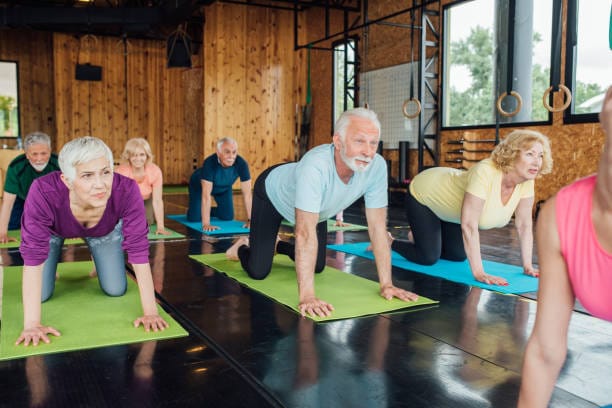
Yoon's go-to recommendation for anyone starting out is cat-cow – the yoga staple that involves moving the spine between arched and rounded positions, usually on all fours.
He anticipates the reaction. "When I say 'do cat-cow for 10 reps a day', it doesn't sound exciting."
But he's unrepentant about it, because the movement earns its place. "It works the spine, neck, hips and pelvis all at once," he says. "It doesn't require any equipment." For a population that has spent years – often decades – sitting in chairs, it addresses exactly the accumulation of stiffness that makes getting up from those chairs gradually harder.
The broader principle is simple: "Less is more, but you have to do it regularly."
And the baseline is even simpler: "If you don't use it, you lose it. Walk, stretch, reach your hands over your head – simple things anyone should do."
His book, Better Stretching, published in 2020, distils his method into routines designed to take nine minutes. Not because that's an optimal scientific dose, but because nine minutes is achievable. It's below the threshold where people talk themselves out of starting.
The real barrier isn't the exercise.
One of Yoon's more useful observations is about why people don't do mobility work even when they know they should. It's not ignorance. It's that mobility doesn't come with visible results or the kind of immediate feedback that keeps people committed to strength training or cardio.
You don't finish cat-cow and feel a pump. You don't track mobility improvements the way you track weight lifted or kilometres run. The gains are felt rather than measured – in the morning getting out of bed, in the afternoon not reaching for a painkiller, in the moment you bend over without bracing for it.
"Fitness often focuses on flashy promises," he says. That's what gets clicks and sells programmes. A ten-rep cat-cow sequence doesn't.
And yet these small, consistent actions are precisely what yields long-term results for older adults. "The goal isn't extreme flexibility or elite performance," he says. "It's about having a body that supports your life instead of limiting it."
Yoon recently became a first-time parent – a development he says has sharpened his own appreciation for consistency. "It highlights how limited time can be and how challenging it is to balance everything. It also reinforces the importance of practising what you preach."
Nine minutes. No equipment. No flashy promise. Just the quiet, compounding work of keeping the body able to do what you ask of it.
Actionable takeaways for L-Plate Retirees:
Treat mobility as a pillar, not a side dish. Yoon's core argument is that mobility sits alongside strength and cardio rather than below them – particularly from your fifties onwards. If your current routine doesn't include it, it has a gap that will widen over time.
Start with the hips and thoracic spine. These are the two areas Yoon identifies as upstream causes of the pain people typically feel elsewhere – in the knees, shoulders, and elbows. Addressing restrictions here before they become problems is the intervention that prevents the need for a bigger one later.
Do cat-cow. Seriously. Ten reps, daily or near-daily, no equipment. It mobilises the spine, neck, hips, and pelvis simultaneously. It sounds unremarkable, which is exactly why most people skip it, and exactly why Yoon keeps recommending it.
Nine minutes is the target, not the ceiling. The point of the nine-minute framework is that it clears the activation energy barrier. Once you're doing nine minutes consistently, more is easy to add. But consistent nine minutes beats irregular hour-long sessions by a wide margin.
Address causes, not symptoms. If you have recurring pain in a knee or shoulder, consider whether restricted mobility in the hips or mid-back might be upstream. Treating the symptom without addressing the source is how people cycle through physio indefinitely.
The gains from mobility work are felt, not photographed. Easier mornings, less bracing, more range without pain – these don't show up in before-and-after photos. That makes it harder to stay motivated, which is why building it into a routine matters more than having the perfect programme.
Your Turn:
Yoon says the shift to taking mobility seriously typically happens in your forties or fifties, when stiffness starts interfering with daily life. Where are you on that curve – ahead of it, on it, or already playing catch-up?
Is there a movement you've quietly stopped doing – bending, reaching, turning – because it started to feel uncomfortable? When did you stop, and have you ever addressed why?
Nine minutes a day is the barrier Yoon sets. What's the actual barrier for you – time, motivation, not knowing where to start, or something else?
👉 Hit reply and share your story – your insights could inspire fellow readers in future issues.
If today's issue made you want to get off the chair and do something about it, consider supporting L-Plate Retiree on Ko-fi.
The Key to This $240B Market Is in Your Bloodstream

Every year, $240B is spent on treating the symptoms of osteoarthritis, yet not a single therapy has stopped it. Cytonics not only discovered why, they found an answer hiding inside the human body all along. Their first-generation therapy has already treated 10,000+ patients. Now they're pushing a 200% more potent version toward FDA approval. Claim a piece as an early-stage investor today.
This is a paid advertisement for Cytonics Regulation CF offering. Please read the offering circular at https://cytonics.com/
If these insights resonate with you, you’re in the right place. The L-Plate Retiree community is just beginning, and we’re figuring this out together – no pretense, no judgment, just honest conversation about navigating this next chapter.
Subscribe now to receive daily insights, practical tips, and the occasional laugh to help you thrive in retirement. We speak human here – no jargon without explanation, no assuming you’ve been investing since kindergarten.
And if today’s investing note hit the spot, you can buy us a coffee on Ko-fi ☕. Consider it your safest trade of the week – low risk, high return (in good vibes).
Because retirement doesn’t come with a manual… but now it does come with this newsletter.
The L-Plate Retiree Team
(Disclaimer: While we love a good laugh, the information in this newsletter is for general informational and entertainment purposes only, and does not constitute financial, health, or any other professional advice. Always consult with a qualified professional before making any decisions about your retirement, finances, or health.)
Reply