- L-Plate Retiree
- Posts
- The Joint Supplement in Your Cabinet and a New Dementia Question
The Joint Supplement in Your Cabinet and a New Dementia Question
A large records study linked glucosamine to higher death risk in people with dementia. It is an association, not proof, so talk to your doctor.
In partnership with


because retirement doesn’t come with a manual

S&P 500 closes above 7,800 for the first time. Yields ease, oil slips, tech leads again.
The quick scan: Tuesday delivered a quiet record. The S&P 500 closed above 7,800 for the first time, a day after the Nasdaq set its own all-time high. Treasury yields stepped back from levels not seen since 2002, oil eased after the G7 committed 100 million barrels of emergency reserves, and tech and power stocks did the heavy lifting. Underneath, the rally was narrower than the headline suggests: the Russell 2000 fell 0.57% and healthcare stocks were hammered.
S&P 500: +0.58% to 7,818.93 – a first-ever close above 7,800 and a fresh record; Constellation Energy jumped more than 12% after signing a 20-year nuclear power deal with Google to supply its AI buildout
Dow Jones: +0.49% to 51,521.28 – up 253.38 points; Cisco, Walmart and Amazon led the gains, while Salesforce and Boeing were the weakest names in the index
NASDAQ: +0.45% to 27,599.79 – a second straight record close; Marvell rose more than 7% on bullish long-term revenue targets, while storage names Seagate and Western Digital slid sharply
What's driving it: Bonds, mostly. After a global sell-off pushed long-term yields to multi-decade highs, Treasury yields eased across the curve on Tuesday, taking some pressure off richly valued tech. Oil helped too: the G7 announced it will release 100 million barrels of reserves over four months, frontloaded with diesel, as Gulf exports showed signs of recovery. With rates and crude both cooling, investors turned back to earnings, where expectations for the coming season have been revised up to nearly 30% growth, according to FactSet figures cited by Capital.com. Not everything was rosy. The US trade deficit widened to $105.6 billion in August, its largest since March 2025. Iran has stepped up attacks on tankers in the Strait of Hormuz, keeping the oil rebound fragile. And Michael Burry said the market is in the "denial" stage of grief over the AI trade. Records and warnings arrived on the same day.
Bottom line: A record close feels like a verdict. It is not. It is one data point in a market still juggling bond yields above 5%, a war in the Gulf and a rally concentrated in a handful of tech and AI names – small caps actually fell. For L-Plate Retirees, the rule from today's article applies here too: one session is a signal to note, not an instruction to act. Do not chase the record and do not fear it. Check your allocation against your plan, then get on with your day.
Men, Say Goodbye to Eyebags, Dark Spots & Wrinkles
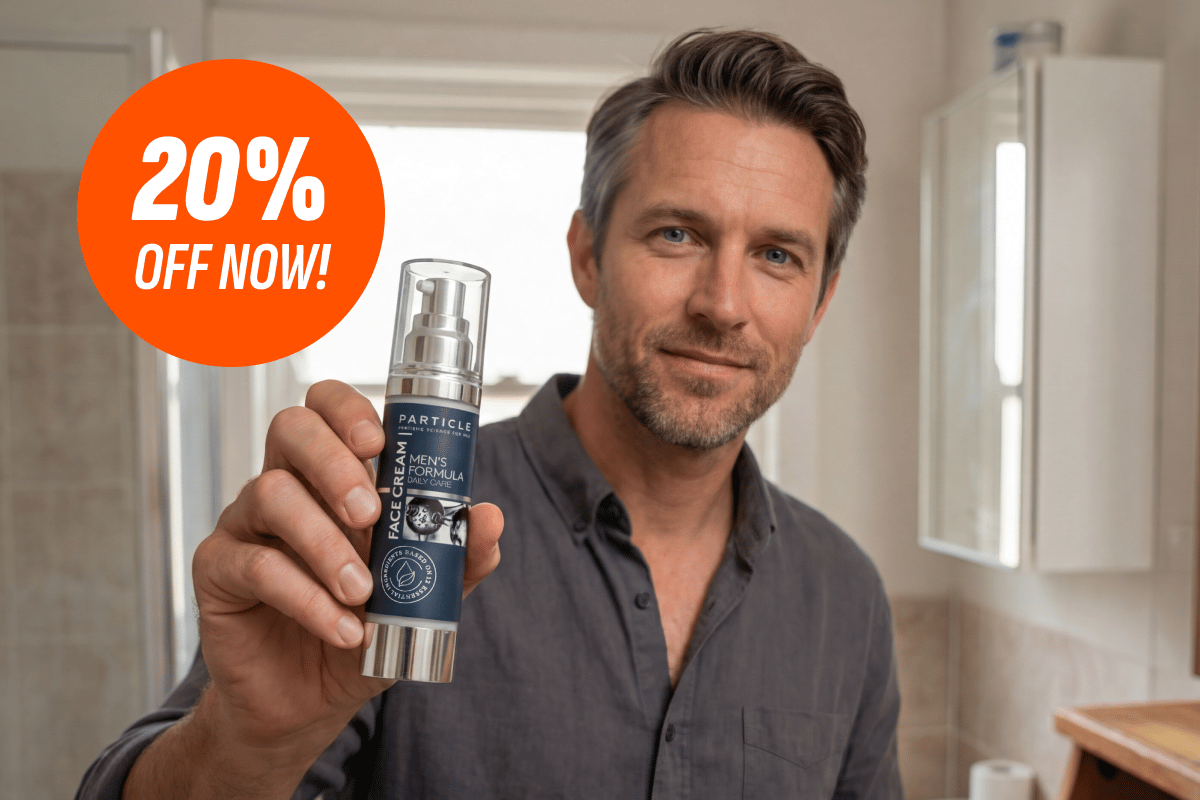
Particle Face Cream is a 6-in-1 formula engineered specifically for men's skin. It reduces eye bags, dark spots, and wrinkles, restores firmness, hydrates deeply, and revives dull tone. Multiple premium anti-aging ingredients, clinically researched, built into one product that actually fits your routine.
Over 1,000,000 men have added Particle to their daily routine. Easy, effective, and worth the two minutes. Try it risk-free with a 30-day money-back guarantee.

A Supplement for Your Knees, a Question for Your Brain?

The scoop: Somewhere near the toothbrushes in a great many homes sits a tub of glucosamine. It was bought for a creaky knee or a stiff hip, it gets taken with breakfast, and nobody gives it much thought. According to AARP, up to one in four older Americans take it, and Americans spent $2.5 billion on it in 2025.
So it is no small thing that a study from the University of Florida linked glucosamine use to worse outcomes in people who already have dementia. The paper first appeared in Nature Metabolism in June, and it has been doing the rounds again since late September. It is not brand-new, but it deserves a calm read rather than a panicked trip to the bin.
What the researchers looked at
The team went through deidentified UF Health medical records from 2012 to 2024, using AI tools developed by researchers Yi Guo and Jiang Bian. They focused on two groups of patients: people with Alzheimer's disease and related dementias, and people with mild cognitive impairment, or MCI. MCI is the stage where memory and thinking have slipped noticeably, but daily life is still largely manageable.
Across those two groups, the records covered tens of thousands of people. Of those, 1,896 people with dementia and 2,750 with MCI had used glucosamine. The researchers then compared users with non-users, adjusting for age, sex and demographic differences.
This was a retrospective study. Nobody was handed a supplement or a dummy pill; the researchers looked back at choices people had already made.
What they found
The clearest result was in the dementia group. Among people already living with Alzheimer's or a related dementia, glucosamine use was associated with a 25% higher risk of death, according to UF. AARP, which reported the study independently, adds a useful detail: the higher risk applied to dementia patients who had used glucosamine for more than a year, measured over ten years.
In the MCI group, there was no link between glucosamine and mortality.
The MCI story gets murkier when it comes to memory decline. UF's release says glucosamine use was associated with a 25% higher likelihood of MCI progressing to dementia. AARP describes users as only "slightly more likely" to progress. Treat that link as smaller and less certain than the headline number.
Why a joint supplement might reach the brain at all
Glucosamine is a sugar-related molecule, and it can cross the blood-brain barrier, the body's security checkpoint that keeps many substances out of the brain.
Once inside, it feeds a process called glycosylation. Think of it as sugar-tagging: the body attaches small sugar molecules to proteins, a bit like sticking labels on boxes so they get sorted to the right place. That is normal and necessary. But the Florida team found this tagging was overactive in Alzheimer's disease. Too many labels, so to speak, on too many boxes.
Two other strands of their work point the same way. When the researchers examined human Alzheimer's brain tissue from the UF brain bank, working with Dr Stefan Prokop, they found significantly more sugar attachment than in tissue from people without the disease. And in mice, giving glucosamine increased the sugar-tagging and worsened a form of recognition memory. When the researchers chemically suppressed the tagging, memory improved.
That is a coherent chain: a plausible mechanism, a signal in human brain tissue, an effect in mice, and an association in patient records. It is also, at every link, short of proof.
The brakes on this story
First and most important, this is an association, not cause and effect. People who take glucosamine may differ from people who do not in ways the records never captured.
Second, mice are not people.
Third, this is one US health system. The results may not hold elsewhere.
Fourth, the wider research is mixed. AARP notes that some earlier studies linked glucosamine to a lower risk of vascular dementia, while others found no link at all.
Gentry, one of the study's authors, called the finding an association rather than proof of causality, but said it raises "an important clinical question that now deserves much more attention." The team says a controlled clinical trial in humans is needed, and that their results do not establish that people should stop taking glucosamine.
Who this is about, and who it is not
The study looked at people who already have MCI or dementia. It says nothing about healthy adults taking glucosamine for their knees. If you are 58, sharp as a tack and fond of your morning tub, this study was not about you.
It does matter for a lot of families, though. Sun, another of the authors, notes that about 7 million Americans live with Alzheimer's. Many of them are older adults who may well have a supplement or two in the daily routine, often started years before any memory diagnosis and never revisited.
What to do with a question rather than an answer
This study does not tell anyone to stop or start anything. What it does is turn a forgettable supplement into something to mention out loud.
Supplements have a way of becoming invisible. They are not prescriptions, so they do not always come up when a doctor reviews medications. They feel like food, so we stop thinking of them as active substances. This study is a reminder that a molecule sold for joints can travel further than the joints.
The useful move is a conversation, not a decision made alone at the kitchen bench. If you, or someone you care for, has MCI or dementia and takes glucosamine, bring it up with the doctor. Let them weigh it against everything else they know about that person.
And then, like the researchers, wait for the trial.
Actionable takeaways for L-Plate Retirees:
Know who the finding applies to. The study looked only at people who already had mild cognitive impairment or dementia. It did not test healthy adults, and it should not be read as a warning about glucosamine for everyone.
Treat it as a question, not a verdict. This was a retrospective look at medical records from one US health system. It shows glucosamine and worse outcomes travelling together, not that one caused the other. The researchers themselves say a controlled human trial is needed, and earlier studies point in different directions: some linked glucosamine to a lower risk of vascular dementia, others found no link at all.
Put your supplements on the table at your next appointment. Many of us list our prescriptions and forget the tubs in the cabinet. Bring a list, or the bottles themselves, and ask your doctor whether anything you take deserves a rethink given your own health. Do not stop or start glucosamine on your own on the strength of one study.
If you care for someone with memory problems, check the routine together. Supplements started years ago can quietly continue long after a diagnosis changes the picture. Make a full list of what your parent, partner or friend takes each day, and raise glucosamine specifically with their doctor or care team.
Remember that "natural" is not the same as "inert". Glucosamine is a sugar-related molecule that can cross into the brain and feed a biological process the researchers found overactive in Alzheimer's. Anything that does something in the body deserves the same respect as a prescription.
Watch for the trial, not the next headline. One study has raised a question. A randomised trial is what could answer it. Until then, a calm conversation with your doctor beats both panic and dismissal.
Your Turn:
Did you know glucosamine can cross into the brain, or had you always thought of it as something that only works on your joints?
If you or someone you care for takes a supplement every day, when did you last mention it to a doctor – and did they ask about it, or did you have to bring it up?
When a single study raises a question like this one, what would it take for you to change a long-standing habit: a larger trial, your own doctor's advice, or something else entirely?
👉 Hit reply and share your thoughts – your answers could inspire fellow readers in future issues.
☕ If this issue helped you see why a common joint supplement has become a question for the memory clinic rather than a verdict for your kitchen bin, consider shouting L-Plate Retiree a coffee on Ko-fi. Your support keeps these calm, no-hype readings of new health research coming.
25% more hydrated skin in 15 days. Pique's Radiant Skin Duo (Sun Goddess Matcha + B·T Fountain) supports glow from within. Through Oct 11, get a free Nectar Sweetener with any $115+ order. Shop Pique Week →
The L-Plate Retiree community is just beginning, and we’re figuring this out together–no pretense, no judgment, just honest conversation about navigating this next chapter.
Subscribe now, or share it with a friend, to get weekly insights, practical tips, and the occasional laugh to help you prepare for or thrive in retirement. Unlike other newsletters that assume you already know everything, we keep it simple and human.
And if today’s lifestyle musings brightened your day, you can toss a coffee into our Ko-fi tip jar ☕. Think of it like leaving a tip for your favourite busker – only this busker writes about retirement.
Because retirement doesn’t come with a manual… but now it does come with this newsletter.
The L-Plate Retiree Team
(Disclaimer: While we love a good laugh, the information in this newsletter is for general informational and entertainment purposes only, and does not constitute financial, health, or any other professional advice. Always consult with a qualified professional before making any decisions about your retirement, finances, or health.)
Reply