- L-Plate Retiree
- Posts
- Why Your Single Exercise Routine Is Quietly Shortening Your Life
Why Your Single Exercise Routine Is Quietly Shortening Your Life
Harvard tracked 111,000 people for 30 years and found exercise variety – not just exercise amount – reduces premature death risk by 19%
In partnership with


because retirement doesn’t come with a manual
Who would have guessed? Diversification also works in fitness!
CS

The Fed spoke. The market didn't like what it heard.
The quick scan: Wednesday's two-day bounce died on contact with the FOMC. The Fed held rates steady as expected, but the accompanying commentary – and the rate projections – delivered a message markets had been hoping to avoid: no cuts this year, and inflation risks are real. All three indices sold off sharply, with the Dow posting a new closing low for 2026 and falling through its 200-day moving average.
S&P 500: –1.36% to 6,624.70 – a 16-week closing low, erasing both days of the post-Monday rally in a single session
Dow Jones: –1.63% to 46,225.15 – closed below its 200-day moving average for the first time this cycle, down more than 5% for the month. Worst month since 2022 is now in sight
NASDAQ: –1.46% to 22,152.42 – tech took its share of the selling; no sector was spared.
What's driving it: The Fed voted 11–1 to hold rates in the 3.5%–3.75% range, citing the inflationary implications of higher energy prices alongside tariff risks. In its post-meeting statement, the FOMC acknowledged that developments in the Middle East carry "implications for the US economy" – careful language that markets read as hawkish. A large group of members projected zero rate cuts for all of 2026, aligning with rate futures that have been sceptical of cuts for weeks. Powell's press conference didn't help. Consumer staples bore the brunt of the selling – McDonald's, P&G, and Home Depot all fell more than 3% – while Lululemon dropped after its full-year sales and earnings guidance came in below expectations. The brief airline-led optimism of Tuesday evaporated entirely.
Bottom line: The Fed has now explicitly told markets what many feared: higher energy prices and tariff pressures mean inflation stays elevated, and rate relief isn't coming this year. For L-Plate Retirees, this is the scenario that makes cash and short-duration bonds earn their keep. A 200-day moving average breach on the Dow is a technical signal worth watching – if it holds below that level, the downside case gets more credible.
You Can't Automate Good Judgement
AI promises speed and efficiency, but it’s leaving many leaders feeling more overwhelmed than ever.
The real problem isn’t technology.
It’s the pressure to do more with less — without losing what makes your leadership effective.
BELAY created the free resource 5 Traits AI Can’t Replace & Why They Matter More Than Ever to help leaders pinpoint where AI can help and where human judgment is still essential.
At BELAY, we help leaders accomplish more by matching them with top-tier, U.S.-based Executive Assistants who bring the discernment, foresight, and relational intelligence that AI can’t replicate.
That way, you can focus on vision. Not systems.

The One Fitness Mistake Most Retirees Make Without Knowing It
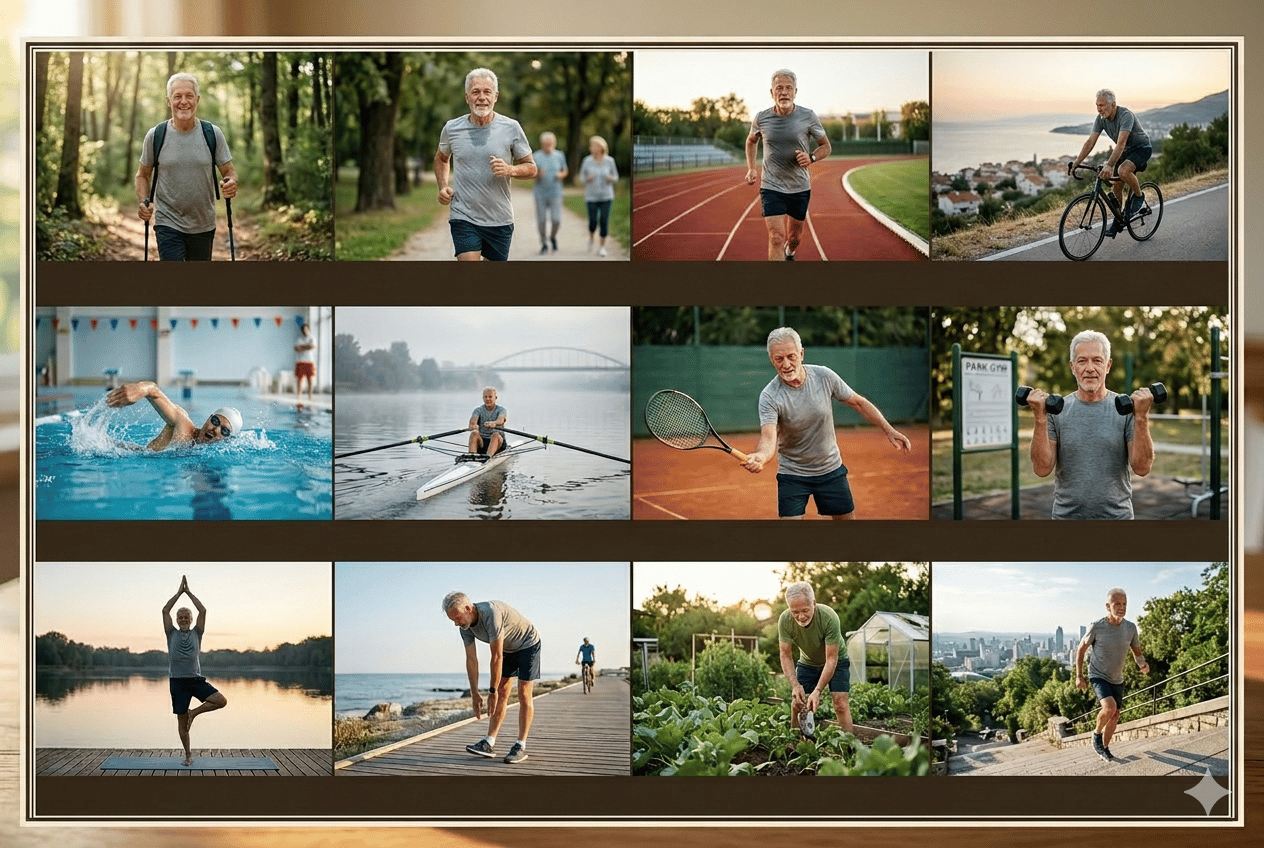
the journey to 12 different exercises starts with one
The scoop: Let me guess. You've got a thing you do.
Maybe it's walking. Every morning, same route, same pace, same forty minutes, reliable as the sunrise. Or maybe it's the pool on Tuesday and Thursday – thirty laps, done, shower, coffee. Perhaps it's the bike, or the treadmill, or the gentle yoga class with the instructor who plays Norah Jones.
Whatever it is, you do it consistently. You show up. You tick the box. And fair play to you – most people don't even do that.
Here's the uncomfortable part, though: according to a significant new study out of Harvard, doing one thing – even doing it very well, very consistently – might be leaving a substantial chunk of your longevity potential on the table.
The research, published in BMJ Medicine in January 2026 by Harvard T.H. Chan School of Public Health, tracked more than 111,000 adults over 30 years – drawing from the long-running Nurses' Health Study and the Health Professionals Follow-Up Study. Participants reported their weekly exercise across twelve different activity types: walking, jogging, running, cycling, swimming, rowing, tennis, resistance training, yoga and stretching, gardening and yard work, and stair climbing.
The researchers weren't just looking at how much people exercised. They assigned each participant a "variety score" – essentially, how many different types of exercise they engaged in consistently. Then they looked at outcomes.
The finding was striking: people who engaged in the highest variety of exercise had a 19% lower risk of premature death compared to those who did the lowest variety. And here's what made it genuinely significant – this held true across every level of total physical activity. In other words, the variety effect wasn't just a proxy for doing more exercise. At low, medium, and high activity levels alike, variety consistently added a protective benefit.
The research team was careful to note what this actually means in practice. The mechanisms aren't fully mapped, but the logic is compelling. Different types of movement stress different physiological systems – cardiovascular fitness, muscular strength, balance, flexibility, coordination, bone density. A single-modality routine can optimise one of these quite well while leaving the others largely untouched.
Walk every day and your cardiovascular system benefits. But your muscle mass, your bone density, your balance under load – these are running on their own independent timelines, which walking alone doesn't adequately address. Add resistance work and balance training to the mix, and you begin to build what researchers increasingly call "resilience" – the capacity of the body to handle diverse stressors without breaking down.
The corresponding author, Yang Hu, put it practically: "People naturally choose different activities over time based on their preferences and health conditions. When deciding how to exercise, keep in mind that there may be extra health benefits to engaging in multiple types of physical activity, rather than relying on a single type alone."
For those of us somewhere in the 45–70 window, this isn't abstract. It's quite specific. We are at the exact age where muscle mass begins to decline meaningfully, where balance becomes a genuine fall risk, where bone density matters for outcomes that aren't just fitness-related but quality-of-life-defining. Walking is genuinely good. Resistance training is genuinely good. Yoga or stretching is genuinely good. But the research suggests the combination – even at modest levels of each – outperforms any single approach.
There's a secondary finding worth noting. The researchers observed that the variety effect didn't require adding a huge amount of new activity. A higher variety score even at low total activity volumes still showed benefit. This isn't a call to overhaul your life or train like someone preparing for an Ironman. It's a call to add a second dimension – and then perhaps a third – to what you're already doing.
Which brings up the obvious question: what should you add?
If you're primarily a walker, the research suggests resistance training is the highest-value add – preserving the muscle mass and bone density that walking can't address, and dramatically reducing fall risk. Even bodyweight exercises done at home – squats, modified push-ups, lunges – qualify.
If you're primarily strength-focused, adding something aerobic – even gentle cycling or swimming – brings cardiovascular and metabolic benefits that resistance work doesn't provide.
If you do neither, the entry point is wherever the friction is lowest. A 15-minute walk three days a week is where decades of health research have found the most significant gains per unit of effort. Start there, then add variety when you're ready.
The beauty of this finding is that it makes the exercise conversation less about duration and intensity, and more about curiosity. What haven't you tried? What did you used to do and stopped? What might your body actually enjoy if you gave it a chance?
Actionable takeaways for L-Plate Retirees:
Audit your exercise portfolio the way you'd audit your investment portfolio. If everything is in one asset class – walking, cycling, yoga – you're missing diversification. List what you do, then identify the obvious gaps: cardiovascular fitness, strength, flexibility and balance. Aim to touch at least two or three categories each week.
Resistance training is the highest-value addition for most retirees. Muscle mass decline accelerates from the mid-50s. Strength training – even two sessions of 20–30 minutes per week – preserves muscle, bone density, and metabolic function in ways no amount of cardio can replicate. Bodyweight exercises at home count.
Don't dismiss "incidental" activity as a variety contributor. The Harvard study counted gardening, stair climbing, and yard work alongside formal exercise types – and they were associated with real protective benefits. Getting out of the gym mindset opens up a much wider menu.
Variety matters even at low total volumes. If you're not a high-exerciser, the research still supports adding a second modality. An extra 15-minute walk on two days plus one session of stretching or yoga each week moves you meaningfully up the variety curve without requiring a lifestyle overhaul.
Balance and flexibility deserve specific attention from your mid-50s. Falls are one of the most significant health risks for older adults – and balance training has clear evidence for reducing fall incidence. Yoga, Tai Chi, and simple single-leg balance exercises are all evidence-supported and accessible.
Think of variety as exploration, not obligation. The research framing here is actually liberating: you don't need to do more – you need to do different. Try a swimming session. Borrow a neighbour's bicycle. Join a stretching class. Your body is designed to respond to variety; it's novelty that keeps adaptation happening.
Your Turn:
What's your go-to exercise – and when did you last add something genuinely different to the mix?
If you're being honest, which category do you most reliably skip: cardiovascular, strength, or balance and flexibility?
Is there a form of movement you used to enjoy and quietly dropped along the way – and what would it take to pick it back up?
👉 Hit reply and share your story – your insights could inspire fellow readers in future issues.
If this newsletter helped you see that proper form matters more than how heavy you lift, consider supporting L-Plate Retiree on Ko-fi. Your support keeps these fitness reality checks coming.
The Best Place to Invest $1,000 Right Now

This AI tech could go down in history as the crown jewel of Elon's career. It could send ChatGPT offline forever and trigger a 70X investment boom. Watch the free presentation.
If these insights resonate with you, you’re in the right place. The L-Plate Retiree community is just beginning, and we’re figuring this out together – no pretense, no judgment, just honest conversation about navigating this next chapter.
Subscribe now to receive daily insights, practical tips, and the occasional laugh to help you thrive in retirement. We speak human here – no jargon without explanation, no assuming you’ve been investing since kindergarten.
And if today’s investing note hit the spot, you can buy us a coffee on Ko-fi ☕. Consider it your safest trade of the week – low risk, high return (in good vibes).
Because retirement doesn’t come with a manual… but now it does come with this newsletter.
The L-Plate Retiree Team
(Disclaimer: While we love a good laugh, the information in this newsletter is for general informational and entertainment purposes only, and does not constitute financial, health, or any other professional advice. Always consult with a qualified professional before making any decisions about your retirement, finances, or health.)
Reply