- L-Plate Retiree
- Posts
- Yoga and Pilates Linked to Lower Mortality in 55,000 US Adults
Yoga and Pilates Linked to Lower Mortality in 55,000 US Adults
Of 21 complementary practices in a large US study, only yoga and Pilates stayed linked to lower mortality. Here is what that does and does not mean.
In partnership with


because retirement doesn’t come with a manual
Turn today's calls into tomorrow's proposal

Wispr Flow Notetaker brings your meetings into Claude or ChatGPT through a built-in connector. Ask for a proposal draft or a deal recap, and your AI works from an accurate record of what was said.

Fed held. Two officials wanted a hike. The 10-year yield topped 5%. Stocks edged higher.
The quick scan: Wednesday was Fed day, and the Fed did what almost everyone expected, leaving rates at 3.75% to 4%. The vote was not unanimous: two policymakers wanted a rise. Stocks finished slightly higher, lifted by a few big individual moves rather than a broad rally.
S&P 500: +0.28% to 7,743.98 – up 21.38 points in a quiet session
Dow Jones: +0.19% to 52,475.10 – added 97.53 points, a third straight modest gain
NASDAQ: +0.27% to 26,549.85 – rose 72.04 points; the Philadelphia Semiconductor Index gained 1.75%, per TradingKey
What’s driving it: The Fed held by a 10-2 vote, with Governor Lisa Cook and Cleveland Fed President Beth Hammack dissenting in favour of a quarter-point hike. That split matters more than the hold. Chair Kevin Warsh stressed the commitment to bringing inflation down, and the Fed said incoming data will guide December. The 10-year Treasury yield rose to 5.02%, according to the Motley Fool. Oracle rose about 11% after setting new financial targets, and Vertiv climbed almost 17% on strong AI infrastructure forecasts.
Bottom line: A Fed that holds while two members call for a hike is saying the direction is not settled. For L-Plate Retirees, a 10-year yield above 5% is the number to watch. It raises borrowing costs and shifts the trade-off between bonds and shares, but on its own it calls for no move.
Men, Say Goodbye to Eyebags, Dark Spots & Wrinkles
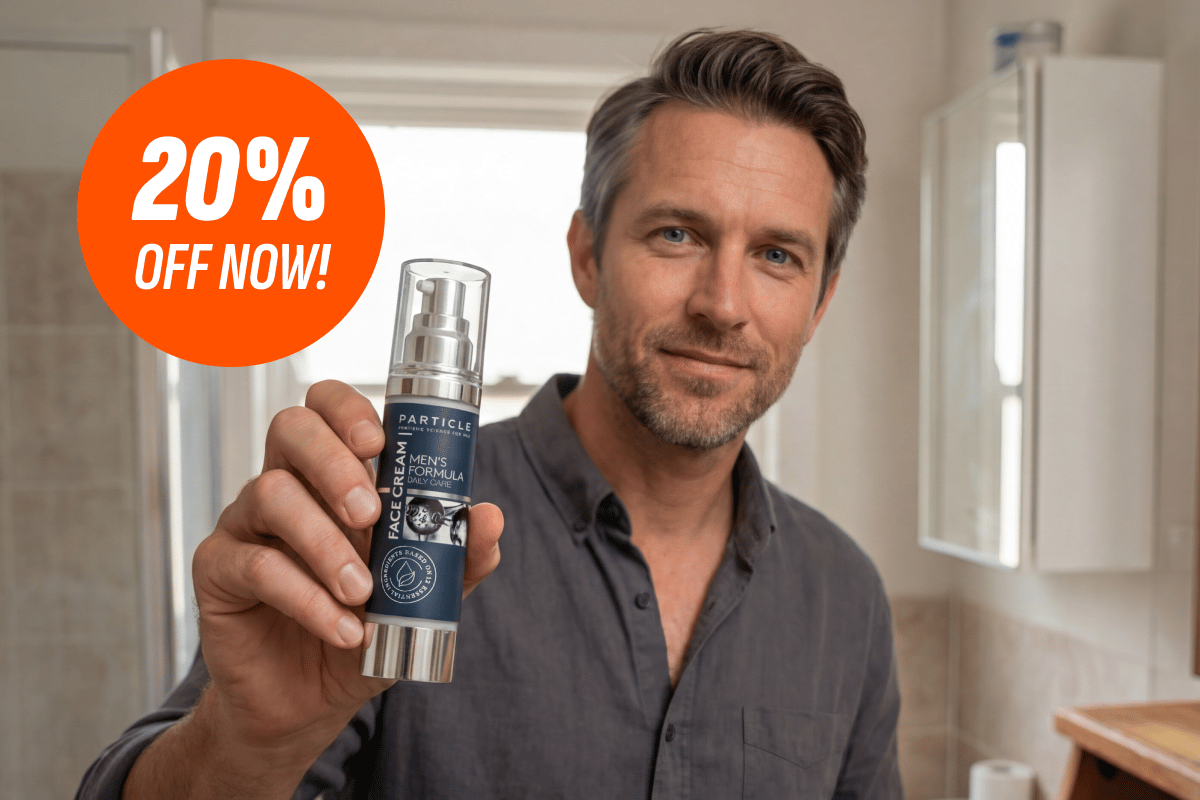
Particle Face Cream is a 6-in-1 formula engineered specifically for men's skin. It reduces eye bags, dark spots, and wrinkles, restores firmness, hydrates deeply, and revives dull tone. Multiple premium anti-aging ingredients, clinically researched, built into one product that actually fits your routine.
Over 1,000,000 men have added Particle to their daily routine. Easy, effective, and worth the two minutes. Try it risk-free with a 30-day money-back guarantee.

Which of 21 Wellness Practices Was Linked to Lower Mortality? Only Two.

The scoop: Twenty-one practices went through the statistical wringer. Acupuncture, massage, homeopathy, yoga, Pilates and more than a dozen others, each compared against who was still alive years later. When the dust settled, only two were still standing: yoga and Pilates.
That is the finding from a study that Arizona State University announced in September 2026, published in the American Journal of Preventive Medicine. A plain note first. We could not open the journal paper itself, so the figures below are as reported by the university and in a commentary by Edzard Ernst, a researcher known as a critic of alternative medicine. Read the numbers as "as reported", and read the whole piece as "a study published this autumn", not breaking news.
Who was counted
The research team, with authors including Connor Sheehan, Paul Espinoza and Yuan Xie, used the US National Health Interview Survey, a long-running national health survey. According to Ernst, they drew on the 2007 and 2012 survey waves and linked respondents to death records through 2019. That gave them 55,023 US adults, 5,530 deaths and 472,636 person-years of follow-up. A person-year is one person followed for one year, so the number is a tidy way of saying "a lot of lives, watched for about a decade". Arizona State describes it in plainer words: more than 55,000 adults, followed for about a decade.
Those adults had been asked about 21 complementary and alternative practices. The researchers then used Cox models, a standard method for comparing how quickly events happen in different groups, to ask which practices were linked to a lower risk of dying during the follow-up.
Why 21 is the interesting number
Test 21 things and, by chance alone, one or two will look impressive. Statisticians call this the multiple comparisons problem, and the team applied a correction called Benjamini-Hochberg to deal with it. Think of it as a stricter referee. A result has to hold up after you account for how many times the dice were rolled, much like a friend who claims a lucky streak at the races but forgets to mention how many bets they placed.
Only yoga and Pilates cleared that bar once the models were fully adjusted. Acupuncture, massage and homeopathy showed no link, and neither did most of the others.
That cuts against a common habit. We tend to hear that everything in the wellness aisle helps a little. Here, almost nothing survived the referee. One caution runs the other way too: "no link found" is not a verdict that acupuncture, massage or homeopathy do nothing. It means this study did not detect an association that held up after the correction, and that is all it means.
The numbers, as reported
In the fully adjusted models, yoga had a hazard ratio of 0.73 (95% confidence interval 0.62 to 0.87). Pilates came in at 0.64 (0.49 to 0.85). Arizona State puts those into plain terms: a 27% lower risk of death for yoga and a 36% lower risk for Pilates.
A hazard ratio below 1 means that group had a lower rate of death over the follow-up than the comparison group. A ratio of exactly 1 would mean no difference at all, so the further below 1 the number sits, the bigger the reported gap. The confidence interval is the range of values the data consider plausible. Pilates has the wider range, so hold its headline figure a little more loosely than the tidy 36% suggests.
"Adjusted" means the researchers statistically accounted for income, education, exercise, smoking, body mass index and self-rated health. Including exercise in that list is an attempt to separate yoga and Pilates from being active in general. No adjustment is perfect, but it matters that the link did not vanish when those factors were held steady.
Ernst also reports a hazard ratio of 0.94 for each additional practice a person used, and 0.76 for people who used several practices. Those figures describe the 21 practices together, not yoga or Pilates alone.
Why this is not proof
The study is observational. It looked at what people said they did and what happened to them later. It did not assign anyone to yoga, Pilates or anything else. So the careful wording is "linked to", and the careful reading is that these practices go with a lower risk of death, not that they bring it about.
The authors and Ernst both flag the usual suspects. People who did yoga and Pilates in this survey tended to be younger, more educated and healthier than those who did not. Adjustment can smooth some of that out, but not all of it.
There is also the question of which way the arrow points. This is called reverse causation. The sickest people may be unable to attend classes in the first place, which would make class-goers look healthier than non-goers even if the classes did nothing at all. A study of this design cannot untangle that.
Three further limits are worth stating plainly. The survey data are not new, since they come from the 2007 and 2012 waves, with deaths counted to 2019. The sample is US adults only, so it says nothing about other countries or regions. And we did not see a funding or conflict-of-interest statement, which is not the same as saying there was a problem.
Where that leaves us
There is something quietly refreshing about a result like this one. It does not tell you to sign up for anything. It does not offer a number of minutes, a weekly dose or a verdict on which kind of exercise is best, because the study cannot support any of that.
What it offers is a pattern: out of a crowded field, two practices that combine movement, breath and attention to the body kept showing up alongside lower mortality, after a stern statistical referee had done its work. That is interesting. It is not a prescription.
Most of us have a friend who swears a class changed their life, and who will tell you so before the tea has cooled. The gentler reading is this. A class may be good for the body, the mood and the diary, and this study adds a small, careful reason to take such classes seriously. But we would be getting ahead of ourselves to say they extend life.
Actionable takeaways for L-Plate Retirees:
Read "linked to" as exactly that. Yoga and Pilates were associated with a lower risk of death in this study, which did not test whether they cause it. Treat the finding as a reason to be curious, not as a promise about how long you will live. Curiosity is cheap, and it keeps you from being sold something on the back of a headline.
Be wary of any practice sold as helping everything. Of 21 practices, only two held up after correction for testing so many at once. When someone tells you their favourite therapy does it all, a fair question is how it would fare against that kind of referee. Most claims would struggle.
Notice that no dose came out of this. The study gives no number of classes, no minutes and no schedule, and it does not show that yoga or Pilates beat other forms of exercise. If you take a class, choose it for how it feels and whether you will turn up, not for a magic frequency. The best routine is usually the one you will still be doing in March.
Remember who is in the picture. Users in the survey tended to be younger, more educated and healthier, and the sickest may have been unable to attend. If you are managing a health condition, that gap matters, so do not assume the result carries over to you. A study of the general adult population is not a study of your particular body.
Treat the figures as reported, not as final. The hazard ratios of 0.73 and 0.64 come from the university and a critic's summary, and the journal paper was not available to us. The survey data are also from 2007 and 2012, with deaths counted to 2019. Wait for the full paper before you quote a number to anyone.
Check with your doctor before starting a new class. This applies most if you have joint, balance, heart or back problems, or any ongoing condition. A good instructor can adapt movements, but your own doctor knows your history, and that is the conversation worth having first.
Your Turn:
Out of everything on the wellness shelf, which practice do you actually keep doing month after month, and what is it about that one that makes it stick?
The study found a link but cannot say which way the arrow points, since the sickest people may simply be unable to attend classes. Does that change how much weight you give to a headline like this one?
If you tried a yoga or Pilates class this month purely for the pleasure of it, with no promise about lifespan, what would you hope to get out of it?
👉 Hit reply and share your story – your insights could inspire fellow readers in future issues.
☕ If this issue helped you see how a result can be interesting and still fall short of proof, consider supporting L-Plate Retiree on Ko-fi. Your support keeps these evidence-first fitness reality checks coming.
Popsmith’s investment round is closing soon. With a patent-pending Popper, a growing line of consumables, and major retail partnerships, it's making its mark on a $21B+ global market. Invest now.
If these insights resonate with you, you’re in the right place. The L-Plate Retiree community is just beginning, and we’re figuring this out together – no pretense, no judgment, just honest conversation about navigating this next chapter.
Subscribe now to receive daily insights, practical tips, and the occasional laugh to help you thrive in retirement. We speak human here – no jargon without explanation, no assuming you’ve been investing since kindergarten.
And if today’s investing note hit the spot, you can buy us a coffee on Ko-fi ☕. Consider it your safest trade of the week – low risk, high return (in good vibes).
Because retirement doesn’t come with a manual… but now it does come with this newsletter.
The L-Plate Retiree Team
(Disclaimer: While we love a good laugh, the information in this newsletter is for general informational and entertainment purposes only, and does not constitute financial, health, or any other professional advice. Always consult with a qualified professional before making any decisions about your retirement, finances, or health.)
Reply